


Stepping up to the Stained-Glass Fugue stage
Ribboned sheet music, an organ stop knob, a wind-up mouse and twin organ pipes weave the fugue, the clockwork pipe organ pays most and a ghost music box scatters. Lead Sheet Lines at low volatility makes this the simplest set in the room for learning how a payline is read.
Stained-Glass Fugue is a set at the Late Piano Room. The hushed end of the night: an organ gallery, two domes, a rainy window, a balance scale and a pastry case.
Stained-Glass Fugue: the set’s paytable
15 paylines run through this set, all of them starting from reel one and all of them nailed in place like stage boards. Each symbol lists what a run of three, four or five brings in, as a multiple of the play amount, and Beauregard’s wild covers for every symbol except the scatter.
 Spectral piano key (wild) 12.4×49.4×329×
 Clockwork pipe organ 9.37×37.5×187×
 Twin organ pipes 5.26×21.9×87.7×
 Wind-up mouse 3.76×14.1×56.4×
 Organ stop knob 2.72×10.9×43.5×
 Ribboned sheet music 1.97×7.37×24.6×
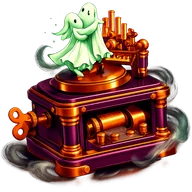 Ghost music box (scatter, pays in any cell) 3.18×23.9×127×
Free spins from the Stained-Glass Fugue band
Scatters cue the free run from any cell: three give 10 spins, four give 15 and five give 25. Catch three or more again mid-run and the band tacks on another batch. Every award inside the feature is paid straight from the paytable.
Lead Sheet Lines on the Stained-Glass Fugue stage
The barest groove on the programme. Paylines run from reel one and stay put, three or more scatters cue a free run, and when the reels go quiet the picture in front of you is the entire round.
Read more about lead sheet lines and the four other sets that share its groove.


